

Clari5 Intelligence Hub
Regulatory data. Bank intelligence. One decision — everywhere it matters.
Intelligence Hub fuses external regulatory feeds with your own internal risk data into a single composite intelligence layer — reused at onboarding, beneficiary addition, every transaction, and every regulatory filing.
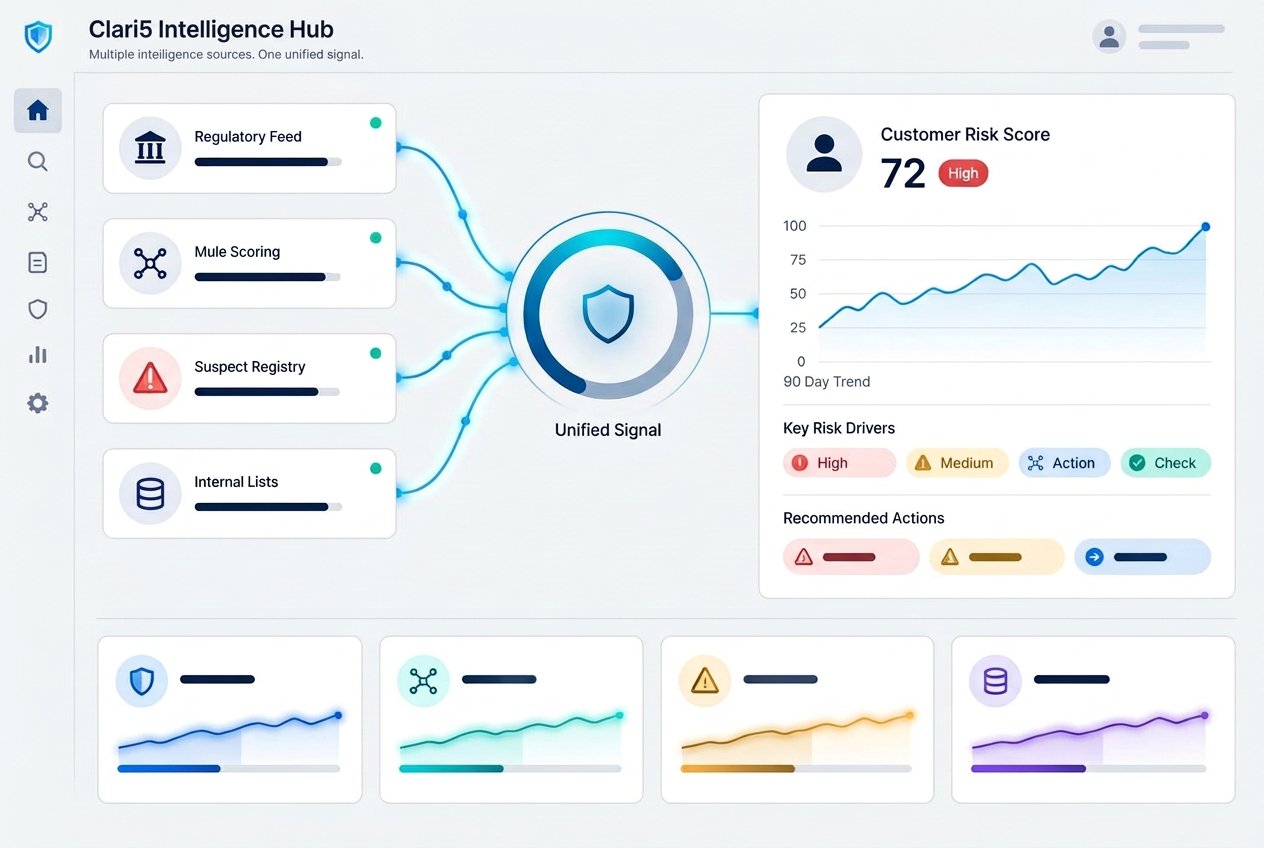
Intelligence sources
fused into one Signal
Touchpoints
onboarding to regulatory filing
REST API
for CBS, EFRM, mobile and branch
Risk trend
live customer-level risk visibility
The problem
Your bank has multiple intelligence sources. Your customer needs one decision.
Modern banks consume intelligence from multiple sources. Some are regulatory — mandated by the DoT for telecom-backed fraud screening. Others come from crime databases, industry consortiums, or the bank’s own risk signals. Each source provides valuable intelligence. Each also creates operational friction.
The result is fragmented decisioning. A customer might be approved by one intelligence check, challenged by another, and blocked by a third — with no consistent logic.
Decisions must hold across
- Customer onboarding
- Beneficiary registration
- Real-time transaction monitoring
- Periodic re-screening
- Investigation and case management
- Regulatory reporting
Today, most banks treat each source as a separate workflow:
C-DOT (FRI, MNRL, Reactivation List)
Separate download, separate SOP, separate action logic
DPIP (MuleHunter)
Separate API, separate risk interpretation, separate threshold
i4C Suspect Registry
Separate screening rules, separate tiered matching
Bank Internal Lists
Separate internal review, separate decision criteria
The gap is operational and strategic: Banks have intelligence. What they lack is a unified framework to apply it consistently across every customer touchpoint.
Intelligence Hub value proposition
Multiple intelligence sources. One decisioning layer.
Intelligence Hub abstracts the source complexity. Regulatory feeds, external fraud intelligence and internal risk signals are fused into a single Signal — consumed at onboarding, in transaction approval, during periodic review and in automated regulatory reporting.
Intelligence fusion
Regulatory, fraud, and bank-defined intelligence in one framework.
Unified decisioning
One proportional action logic across all sources, all touchpoints.
Automated daily data integration
Regulatory feeds and external intelligence updated automatically; no manual downloads or reconciliation.
Single REST API
Any system calls it the same way: CBS, EFRM, mobile banking, branch systems, investigation platforms.
Severity-aware action logic
Responses scale to risk; high-severity matches trigger immediate action, low-severity triggers review.
Continuous customer risk scoring
Live risk signals at customer level with 90-day trend visibility, enabling proactive review.
EFRM alert enrichment
Intelligence and risk scores flow directly into fraud investigation systems.
Automated regulatory reporting
All applicable ATR types generated and submitted automatically after bank action.
The result is not just operational efficiency. It’s decisioning consistency, faster resolution, and an audit trail that is inspection-ready from day one.
Intelligence sources
Multiple segments. One screening layer.
Financial Fraud Risk Indicator
C-DOT — FRI
Mobile numbers flagged for financial fraud risk; severity scores 1 (Very High – Decline) to 3 (Medium – Challenge); ~15-day lifecycle
Mobile Number Revocation List
C-DOT — MNRL
Disconnected/revoked numbers; 6 severity-coded reason codes; proportional action logic (RC 1–2: freeze; RC 3–6: verification)
Reactivation Registry
C-DOT — Reactivation List
Legitimately reconnected numbers — suppresses MNRL actions to prevent false positives on genuine customers
RBI Innovation Hub ML scoring
DPIP (MuleHunter)
Continuous ML-based mule account detection; configurable risk bands
Ministry of Home Affairs
i4C Suspect Registry
Cybercrime suspects: account number, IFSC, mobile, PAN, email — tiered confidence matching
Bank-configured intelligence
Bank Internal Lists
Bank-defined fraud, suspect, or referral lists — independently weighted and screened
Integration model
Intelligence Hub maintains automated connections to all regulatory intelligence sources (C-DOT, MNRL Reactivation) and supports configuration-based activation of extended fraud and risk intelligence (DPIP/MuleHunter, i4C, internal lists). Banks activate only the segments they need; all are evaluated through a single decisioning framework. No separate systems. No manual cross-referencing. One Signal.
Six use cases
One intelligence layer. Six touchpoints. Consistent decisions.
The same fused intelligence, the same decisioning logic, the same audit trail — from first interaction through ongoing monitoring and regulatory compliance.
Use case 01
Customer Onboarding Intelligence
Screen new customers against all configured intelligence sources (C-DOT, DPIP/MuleHunter, i4C, bank internal lists) in one call — one fused Signal, not five separate checks to reconcile.
Use case 02
Beneficiary Addition
Flag repeat or previously-flagged beneficiaries before money movement — remembering what earlier checks found, not just today’s result — with consistent risk logic across all intelligence sources.
Use case 03
Real-Time Transaction Monitoring
Screen inline via EFRM, returning the fused Signal plus a proportional recommended action before the transaction completes — integrated with existing fraud investigation workflows.
Use case 04
Periodic Re-Screening
Re-screen existing customers on a recurring cadence against updated intelligence from all sources — continuous compliance, not a one-time gate at onboarding.
Use case 05
Whitelisting
Clear confirmed-legitimate customers once via a unified framework — automatically or via maker-checker — so they’re never re-flagged across any intelligence source again.
Use case 06
Automated ATR Filing
Capture every action taken across all intelligence-driven decisions and file applicable ATRs to the regulator automatically — one complete audit trail, no manual drafting.
Severity-based action logic
Responses proportional to risk.
High-severity matches trigger immediate action; low-severity matches trigger review. And before every action, Intelligence Hub checks MNRL and the Reactivation List together — so a legitimately reconnected number is never incorrectly blocked.
MNRL Reason Code 1–2
High severityImmediate debit freeze + digital channel block
FRI Score 1–2
Very high / HighBlock at all touchpoints
FRI Score 3
MediumChallenge at transaction; manual review at onboarding
MNRL Reason Code 3–6
Low severitySMS verification only
Key capabilities
Built to integrate once and cover everything.
-
01
Automated C-DOT API Integration
Connects directly to DoT via C-DOT APIs for automated daily FRI and MNRL data fetch. No manual portal downloads. List freshness visible in real time on the Intelligence Hub Dashboard.
-
02
Universal Screening API
One REST API endpoint. Any system calls it the same way: CBS, EFRM, mobile banking, internet banking, digital channels. Integrate once; all touchpoints are covered.
-
03
Reactivation-Aware Screening
Checks both MNRL and the Reactivation List simultaneously before every action. A legitimately reconnected number is never incorrectly blocked.
-
04
Continuous Customer Risk Scoring
A live risk score at CIF level — combining list-based signals with network connectivity analysis — with 90-day trend visibility. See who is trending toward higher risk before a regulatory match occurs.
-
05
Automated ATR Lifecycle
From screening match to bank action callback to ATR generation and regulatory submission. All six ATR types pre-built and regulator-validated. No manual drafting, no format errors, no missed deadlines.
-
06
EFRM Alert Enrichment
Match results, risk scores and ATR event history flow into existing EFRM systems. Investigators see FRI score and MNRL reason code in the alert view. High-severity matches trigger EFRM case creation directly.
-
07
Complete Audit Trail
Every screening decision logged. Every action attributed. Every ATR traceable. Inspection-ready at all times.
-
08
Platform Extensibility
Deploy for DoT compliance. Add i4C Suspect Registry, DPIP (MuleHunter) and internal lists without code changes. New intelligence sources activate via configuration.
Why Intelligence Hub
Built for the way modern banks manage risk.
Automated Intelligence Integration
Connect regulatory and external intelligence sources without manual downloads or reconciliation.
Universal Screening API
Integrate once and extend screening across CBS, EFRM, mobile, internet banking and digital channels.
Risk-Based Decisioning
Translate intelligence into proportional actions based on severity and context.
Reactivation-Aware Screening
Distinguish legitimate reactivated customers from genuine risk signals to reduce false positives.
Continuous Customer Risk Scoring
Maintain a live customer-level risk view with trend visibility for proactive monitoring.
EFRM Alert Enrichment
Bring intelligence, risk scores and relevant history directly into fraud investigation workflows.
Complete Audit Trail
Track screening decisions, actions and regulatory events in one place.
FAQs
Questions about Intelligence Hub.
Intelligence Hub brings regulatory intelligence, external fraud and risk intelligence, and bank-defined intelligence into a single decisioning framework. Instead of managing separate screening workflows for each source, Intelligence Hub converts the relevant signals into one composite Signal that can be consumed across the customer lifecycle.
This enables banks to apply consistent intelligence and risk-based decisioning across onboarding, beneficiary addition, real-time transactions, periodic re-screening, investigation and regulatory reporting.
The challenge is not a lack of intelligence. It is the fragmentation of intelligence across different sources, workflows and decision rules.
When regulatory lists, fraud intelligence, cybercrime intelligence and internal bank lists are handled separately, the same customer can receive different outcomes across different processes. Intelligence Hub addresses this by providing a common framework for applying intelligence and proportional action logic across banking touchpoints.
For Fraud and AML leaders, this creates a more consistent decisioning model while reducing operational dependency on manual cross-referencing and disconnected workflows.
Yes. Intelligence Hub can be integrated with Enterprise Fraud Risk Management (EFRM) to provide a fused Signal and recommended risk-based action before a transaction is completed.
The same intelligence framework can also be used at onboarding, beneficiary addition and periodic re-screening. This allows banks to move beyond a one-time screening model and apply relevant intelligence throughout the customer journey.
Intelligence Hub applies a common, severity-aware decisioning framework across configured intelligence sources. Actions can be proportionate to the severity of the underlying signal rather than treating every match in the same way.
For example, the documented Intelligence Hub model differentiates between higher- and lower-severity C-DOT FRI and MNRL signals and supports reactivation-aware screening. A legitimately reactivated mobile number can therefore be distinguished from a current risk signal before an action is taken.
This approach is designed to help banks avoid unnecessary repeat flagging while maintaining appropriate controls for higher-risk signals.
Intelligence Hub can bring together multiple categories of intelligence within one decisioning framework: regulatory intelligence (C-DOT FRI, MNRL and Reactivation List); fraud and risk intelligence (DPIP/MuleHunter and the i4C Suspect Registry); and bank intelligence (internal fraud, suspect and referral lists).
Banks can activate the intelligence segments relevant to their requirements, while applying them through the same decisioning framework rather than creating a separate workflow for each source.
Intelligence Hub provides a Universal Screening API that allows systems such as CBS, EFRM, mobile banking, internet banking and other digital channels to access the same screening and decisioning layer.
The bank integrates with the common API rather than creating separate integration patterns for every intelligence source. This allows the intelligence framework to be extended across multiple customer and transaction touchpoints while keeping decisioning logic centralized.
Yes. Intelligence Hub maintains a customer-level risk signal and provides 90-day trend visibility, allowing compliance teams to monitor changes in risk over time rather than relying only on the outcome of an individual screening event.
The platform can combine list-based signals with network connectivity analysis and surface customers trending towards higher risk before a new regulatory match occurs. This supports a more proactive approach to customer risk monitoring.
Intelligence Hub maintains an audit trail of screening decisions, actions and regulatory events. Its documented workflow can capture the intelligence match, bank action and applicable regulatory reporting as part of the same lifecycle.
The platform also supports automated ATR generation and submission for applicable reporting workflows, while feeding relevant intelligence, risk scores and ATR event history into existing EFRM investigation systems. This gives investigators and compliance teams a more traceable view of how an intelligence-driven decision was reached and acted upon.
Explore the Clari5 platform
Enterprise Fraud Risk Management
Real-time, cross-channel fraud detection — enriched inline with the fused Intelligence Hub Signal.
Learn MoreCustomer Onboarding Intelligence
Onboarding risk decisions that draw on the same composite intelligence layer.
Learn MoreFrom fragmented intelligence to one intelligent decision.
Intelligence Hub helps banks turn regulatory and risk intelligence into consistent, actionable decisions — wherever risk enters the customer journey.