

Clari5 AML Suite for Insurance
Protect your licence. Protect your leadership. Protect your future.
Advanced AI-enabled AML analytics for the global insurance industry — the risk-based, explainable controls regulators now demand, with audit-ready documentation and 40–60% fewer false positives.
False positive reduction
with explainable AI
Faster STR processing
AI-assisted narratives
Countries goAML-ready
pre-configured reporting
AI decisions logged
explainable · human-reviewed
The global enforcement surge
Insurers are now held to bank-grade AML standards.
Regulators are moving from policy frameworks to aggressive enforcement. FATF mutual evaluations are tightening supervision, and FIUs expect insurers to match banks.
The cost of non-compliance
- Licence revocation and operational restrictions
- Personal liability for compliance officers and senior management
- Loss of bancassurance partnerships, reinsurer scrutiny and correspondent banking restrictions
Insurance laundering typologies
Distinct products. Distinct laundering patterns.
Life, annuities, investment-linked and high-value general insurance present risks that generic bank AML cannot see.
- 01Large premium inflows and early surrenders
- 02Structuring through multiple policies
- 03Refund abuse and third-party funding
- 04Complex beneficiary and nominee relationships
- 05Heavy reliance on agents and intermediaries
- 01Digital and cryptocurrency-funded premiums
- 02Mobile money layering through microinsurance
- 03Sanctions evasion through cross-border premium flows
- 04Trade-based laundering via marine and cargo insurance
- 05Beneficial ownership concealment in corporate policies
- 01Dual-use goods coverage in commercial policies
- 02Beneficial owners linked to sanctioned entities
- 03Trade insurance for high-risk commodities
- 04Shell-company policy structures in high-risk jurisdictions
Coverage across the value chain
Every stage of the policy. One platform.
Detect suspicious behaviour across the full lifecycle, investigate with complete context and file FIU-ready STRs with confidence.
Onboarding & risk assessment
- Centralized KYC for policyholders, beneficiaries, nominees and beneficial owners
- Sanctions & PEP screening against UN, OFAC, EU, regional and local lists
- Duplicate customer and relationship detection
- Customer risk classification with ongoing screening
Policy & premium lifecycle
- Monitor premiums across domestic and international channels
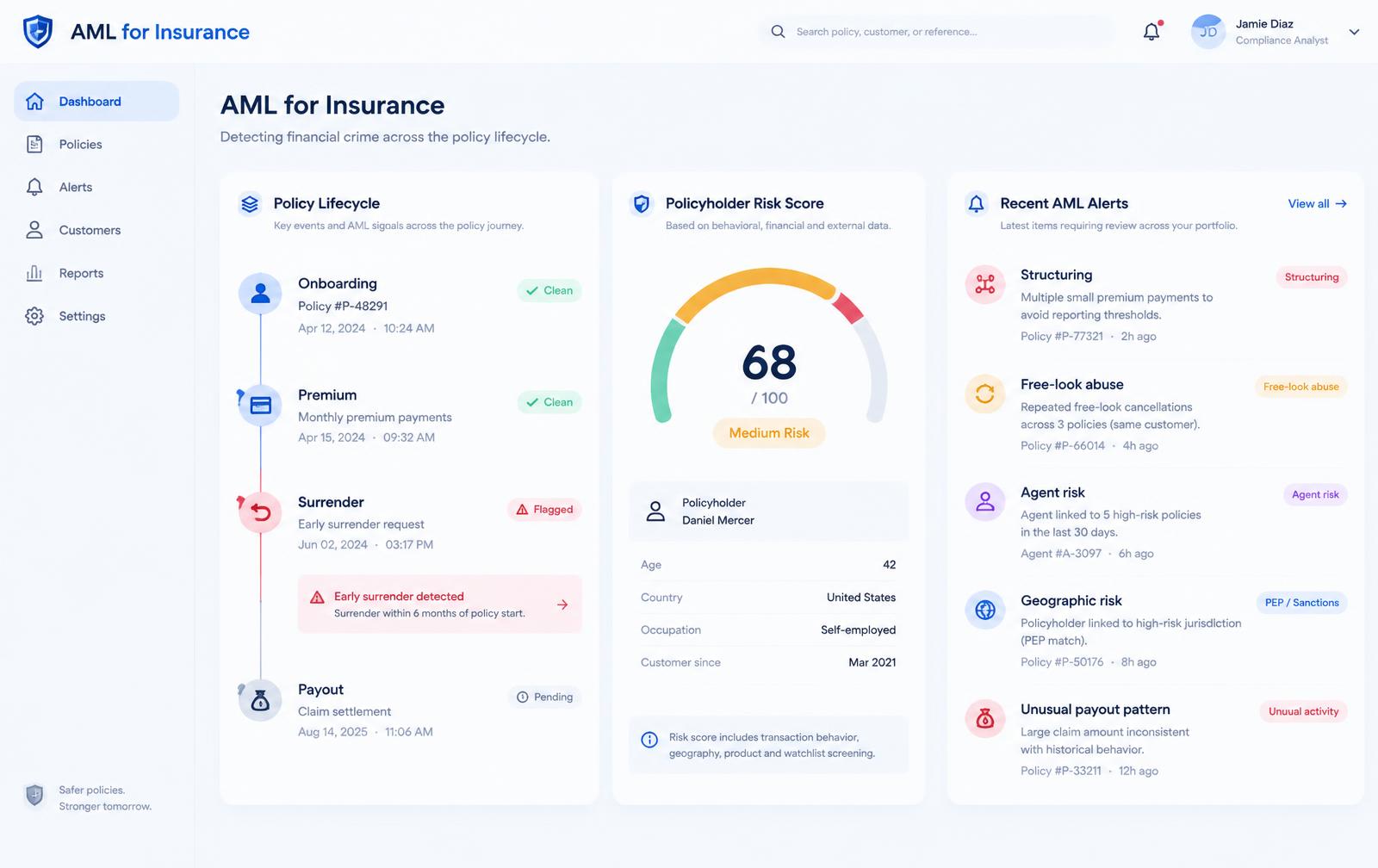
- Detect structuring, overpayments, refunds and unusual funding
- Flag behaviour inconsistent with profile or peer group
- Track policy changes, beneficiary updates and bank detail edits
Claims, surrenders & payouts
- Detect early surrenders, free-look abuse and rapid redemptions
- Screen beneficiaries and payees at payout
- Flag payments to unrelated or high-risk third parties
- Identify repeated bank account changes and abnormal payouts
Agent & intermediary oversight
- Screen agents and intermediaries against watchlists
- Monitor cancellations, repeat red flags and unusual volumes
- Identify concentration risk and agent-linked activity
- Commission pattern analysis with documented supervision
Insurance-focused monitoring
A scenario library built for insurance.
Configurable by policy type, customer risk, product and jurisdiction — running in real time and batch with risk-based overrides.
- Structuring activity
- Round amount activity
- Flow through of funds
- Excessive change in account value
- Sequential monetary instruments
- High-volume / low-value
- Early surrender & free-look abuse
- Overpayment with refund requests
- Dormant policy reactivation
- PEP-linked transactions
- Agent-driven risk patterns
Behavioural analytics
Laundering emerges as a pattern over time — not one large transaction.
- Customer behaviour profiling
- Historical & peer-group comparison
- Cross-policy & cross-entity aggregation
- Deviation & trend detection
Early identification of layering and placement that static rules miss.
AI-powered efficiency
40–60% fewer false positives. 75% faster STRs.
Every AI recommendation is logged, explainable and subject to human review.
Explainable AI
Transparent reasoning showing why alerts triggered, with customer and transaction risk attributes.
Generative AI
Auto-draft regulator-ready STR narratives with Grounds of Suspicion summaries.
Intelligent auto closure
ML closure probability for low-priority alerts, with exclusions and human-in-loop QC.
ML scoring
Risk-based alert prioritization so investigators focus on high-risk cases first.
AI tuning
Analyses historical alerts to recommend threshold and parameter adjustments.
Smart assignment
Workload, typology, branch and risk-based routing with holiday calendar integration.
GenAI spotlight
Regulator-ready STR narratives in minutes, not hours — fully auditable, with mandatory analyst approval before submission.
Built for high-growth markets
What regulators require. What Clari5 delivers.
Investigation, reporting & ecosystem
360° investigations. FIU-ready by design.
A unified case workspace with full customer, policy, transaction and agent context — linked alerts, network views, timelines and maker-checker workflows.
Mobile money
Direct APIs to M-Pesa, MTN MoMo, Orange Money and Airtel Money, with real-time wallet structuring detection.
Multi-currency & cross-border
Premium flows across currencies and channels; detects currency substitution and hawala.
FIU-ready reporting
STR/SAR with goAML, structured validation, full audit trail and MIS for inspections.
Integration-ready
Oracle Insurance, SAP Insurance, Applied Systems, bancassurance partners and reinsurer due diligence.
Aligned with FATF, APG, MENAFATF, ESAAMLG, CFATF and GIABA standards · Production coverage in Africa, expanding across Asia-Pacific and the Middle East.
Compliance risk self-assessment
How exposed are you?
Tick every statement that applies to your organisation.
Your result
0 / 10
Likely adequate
Your controls may be adequate. Verify with a Clari5 assessment.
Book a risk assessment callTake the next step
Smarter defense. Proven results.
Accounts protected
Transactions secured monthly
Financial institutions live
Reduction in false positives
FAQs
Frequently Asked Questions: AML for Insurance
Clari5 AML Suite for Insurance supports anti-money laundering monitoring across customer onboarding, risk assessment, premium payments, policy changes, claims, surrenders and payouts. It connects relevant customer, policy, transaction, beneficiary and intermediary information to help identify suspicious patterns, investigate alerts with greater context and maintain documented decisions. This helps insurers strengthen risk-based AML controls across the policy lifecycle rather than relying solely on isolated transaction alerts.
Insurance companies may face money laundering risks involving large or unusual premium payments, third-party funding, premium overpayments followed by refund requests, early policy surrenders, repeated policy transactions, beneficiary changes and suspicious claims or payouts. Corporate policies may also present risks involving concealed beneficial ownership or high-risk relationships. Clari5 supports insurance-specific transaction monitoring, customer risk assessment and behavioural analytics to help identify activity that warrants investigation.
Clari5 combines configurable insurance-specific monitoring scenarios with customer behaviour profiling, historical comparisons, peer-group analysis and cross-policy aggregation. It can help identify unusual patterns over time, including activity that individual transaction rules may not flag. Risk scoring and explainable AI support alert prioritisation, helping investigators understand why activity was flagged. Detection effectiveness depends on data quality, scenario configuration and the insurer's risk profile.
Clari5 uses machine learning, risk scoring, behavioural analytics and configurable scenario tuning to help prioritise alerts and reduce unnecessary investigation effort. Its intelligent auto-closure capability can support the closure of eligible low-risk alerts under configured criteria and appropriate quality controls. The objective is to direct investigators towards higher-risk cases without removing necessary oversight. Insurers should validate detection performance, false-positive rates and missed-risk controls using their own historical cases before adopting the solution.
Yes. Clari5 supports agent and intermediary screening, activity and commission pattern analysis, and the identification of unusual concentrations or recurring risk indicators. It also supports monitoring of beneficiaries, payout recipients and third-party payment relationships. By connecting relevant parties and activity, the platform helps compliance teams investigate relationships that may be difficult to identify when information is spread across separate systems.
Clari5 supports structured case investigation, documented decision workflows, audit trails and AI-assisted drafting of Grounds of Suspicion narratives for suspicious transaction reports. The solution also supports reporting workflows, structured data validation and management information dashboards. AI-generated narratives require analyst approval before submission. Insurers remain responsible for determining whether a report is required and ensuring that its contents and submission comply with applicable Financial Intelligence Unit (FIU) requirements.
Clari5's insurance AML solution brief describes support for goAML-based reporting and configurable country-specific STR/CTR formats across multiple jurisdictions. The platform is designed to support insurers operating across different regulatory environments. Before implementation, insurers should confirm coverage for each operating country, including local reporting formats, submission requirements, applicable screening lists and the production status of the required capabilities. Regulatory requirements vary by jurisdiction, and the platform does not guarantee compliance by itself.
Clari5 is designed to integrate with insurance systems, payment channels and relevant external data sources. Its insurance solution brief identifies integration capabilities for core insurance platforms, banking partners and mobile money services such as M-Pesa, MTN Mobile Money and Orange Money. Actual integration requirements depend on the insurer's technology environment, available interfaces, data quality and processing needs. Technical discovery should establish the required integrations, implementation scope, data migration approach and expected performance.
Insurers should establish a baseline before implementation and measure outcomes such as false-positive rates, investigation turnaround time, alert ageing, STR preparation time, reporting quality and investigator productivity. They should also assess implementation and operating costs, integration effort and ongoing model governance. Clari5 supports alert management, investigation workflows and compliance reporting intended to improve operational effectiveness. Actual benefits should be validated through a defined pilot or agreed acceptance criteria rather than assumed from vendor estimates.
Insurers should assess insurance-specific detection capabilities, coverage across the policy lifecycle, explainability of AI decisions, regulatory reporting support, auditability, integration requirements, data security and implementation feasibility. They should also examine how the solution performs against their own risk scenarios and whether outcomes can be measured against agreed objectives. A structured evaluation with Clari5 can help insurers identify gaps in existing controls, validate relevant capabilities and determine whether the platform fits their operational and regulatory requirements.
Explore the Clari5 platform
Anti-Money Laundering
Explainable AML monitoring, screening and regulator-ready reporting for banks.
Learn More